
Bone Grafting for Implants
Do I have enough bone for dental implants?
Socket Preservation Grafting
After tooth extraction, the tooth extraction socket will usually fill naturally with bone within four months. Many times, preexisting bone loss is present in the jaw as a consequence of the “diseased” tooth. Also, the healing of bone into an extraction socket is rather unpredictable. For these reasons, Dr. Burns frequently recommends the placement of a bone graft into the tooth extraction site. This is called socket (alveolar ridge) preservation grafting.
This step will maintain the width and volume of bone you will need for implant placement in the months ahead.
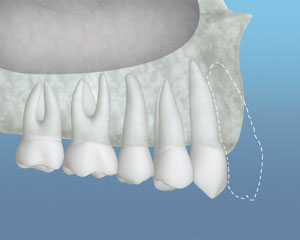
1. Inadequate Bone
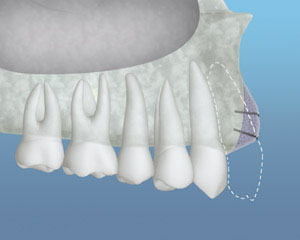
2. Graft Material Placed
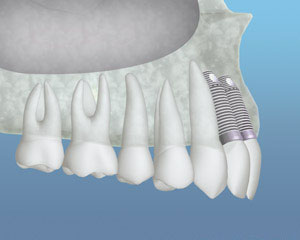
3. Implants Placed
Onlay Bone Grafting
If the tooth/teeth that are to be replaced have been missing for a period of time, there may be inadequate bone for implant placement. This inadequacy occurs as a consequence of bone loss due to lack of stimulation of that bone by the teeth (or by an implant) in the area. This bone loss can occur very quickly (in less than a year after extraction). In this situation, an onlay bone graft can be placed next to the thin bone and allowed to heal for four to six months.
After the graft has adequately healed, the implant can be placed. Bone grafting is usually a relatively comfortable office procedure. It is, however, very unpredictable. It is better to prevent the initial loss of bone through socket preservation grafting and early implant placement. Many different bone-grafting materials are available, including your own bone.
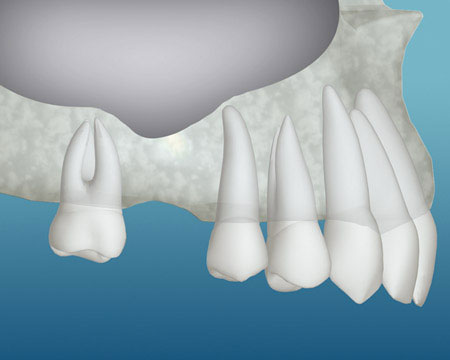
1. Inadequate Bone
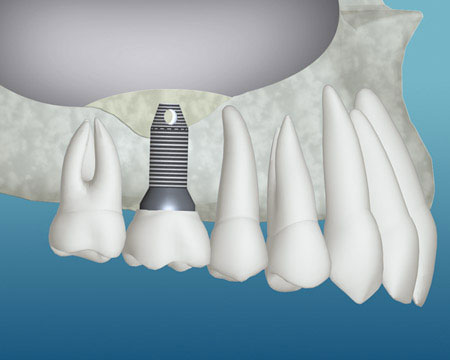
2. Graft Material and Implant Placed
Maxillary Sinus Lift with Grafting
You may require a maxillary sinus lift with grafting if the sinus cavities in your upper jaw are very large or very low and extend into the area of proposed implant placement. An enlarged or “low” maxillary sinus is a common occurrence in the upper (maxillary) posterior jaw. In this case, a “sinus grafting procedure” is then required.
In this procedure, the sinus is entered, the sinus membrane that lines the sinus is elevated, and bone is then added to the “pocket” that was created. Occasionally, a sinus lift and implant placement can occur simultaneously. A sinus lift may be classified as either direct or indirect; Dr. Burns will select the method best suited for your dental needs. A maxillary sinus lift with grafting is performed in the office with local anesthesia and possibly sedation.