

 Onlay Bone Graft
The success of dental implants is dependent on many factors, including the quantity and quality of bone in the area that will host the implant. Occasionally, an insufficient amount of bone is present in the desired location. The possible reasons for this lack of one are many and varied (see Jawbone Loss and Deterioration), but most commonly, it is due to a tooth being removed which causes normal physiologic loss of bone due to lack of stimulation.
Fortunately, several procedures have been developed to regain or strengthen bone which enables a dental implant to be successfully placed. One such procedure is called an onlay bone graft.
How is on Onlay Bone Graft Procedure Performed?
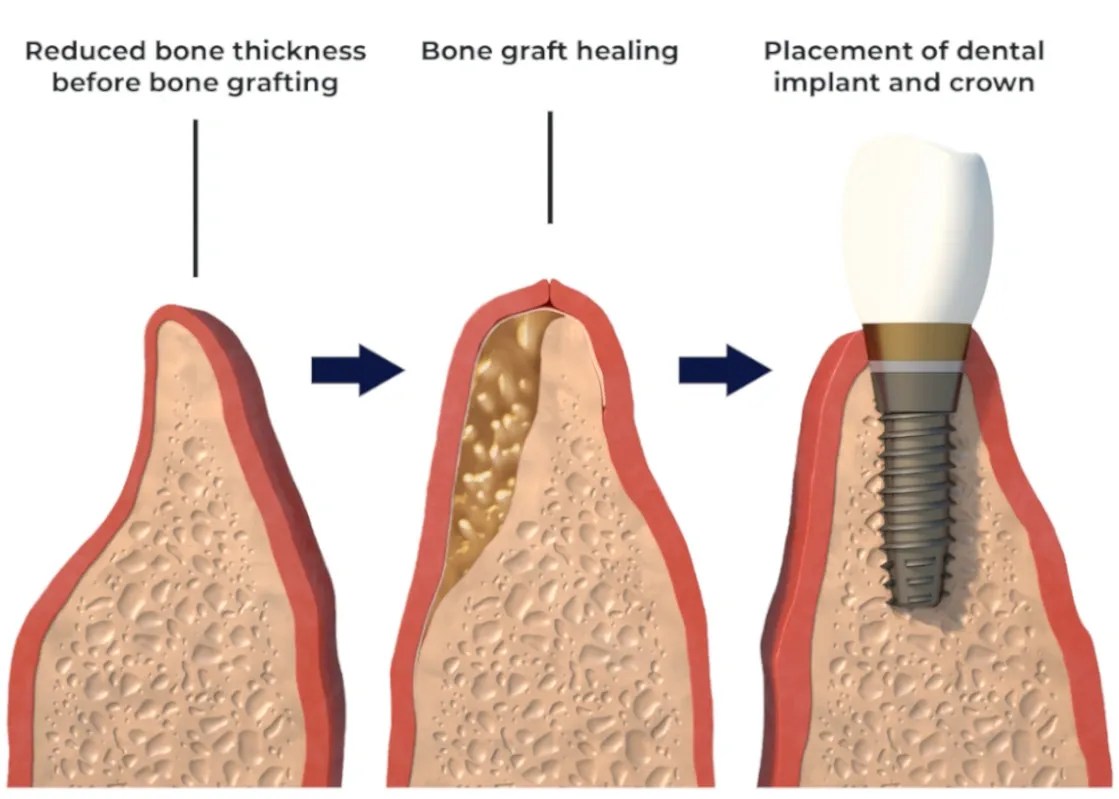
The procedure for placing an onlay bone graft is as follows. After the area has been anesthetized, an incision is made in the area to be grafted. Graft material is then layered in the deficient bony space, using allogeneic, xenogeneic, or autogenous bone, or a combination of these grafting materials. The grafted material is then usually covered by either a resorbable (dissolves over time) or a non-resorbable (must be removed after healing) membrane. The incision is then closed, and the healing begins.
After a healing period of 4 – 6 months, the dental implant can usually be placed. If a non-resorbable membrane was inserted at the grafting appointment, it would be removed at the time of implant placement. Dr. Burns will use advanced 3-D imaging (CBCT) to evaluate the proposed implant location and position both before and after the grafting procedure to ensure feasibility of implant placement.
What is the Difference Between an Onlay Bone Graft and an Alveolar Ridge Bone Graft?
An onlay bone graft differs from an alveolar ridge preservation (socket preservation) graft in that an alveolar ridge preservation graft is performed at the time of tooth extraction, while an onlay bone graft is performed months or years after the tooth has been extracted. On occasion, both an onlay graft and an alveolar ridge preservation graft are necessary to create a quality zone in which to place the implant.