
Missing All Upper or Lower Teeth
WHAT IF I AM MISSING ALL MY LOWER TEETH?
Although many patients have no problem wearing an upper denture, some people find it difficult to wear and eat with lower dentures. Several implant-supported replacement options are available if you are missing all of your lower teeth.
Ball or Locator Attachment Denture
One option is to have at least two but up to five implants placed in your lower jaw and a denture made that “snaps” onto these implants. This option allows your lower denture to be more stable while chewing. Increasing the number of implants placed may increase the amount of stability that can be achieved. Unfortunately, increasing the number of implants placed also increases the cost to patients.
Bar Attachment Denture
Another option involves placing four to six implants into your lower jaw. After healing is complete, the implants are connected with a custom-made support bar. Your denture will be made with special internal retention clips that attach onto the support bar, enabling the denture to snap firmly into place.
The advantage of this option is that it can be much more stable than the first option and allows very little denture movement. Your denture is still removable for easy cleaning and maintenance. This option is typically more costly than a ball (locator) attachment denture due to the custom fabrication methods required by the bar when made by your restoring dentist.
Once again, the denture will require periodic replacement of the clips in order to maintain retention. Continued maintenance of the denture by the restoring dentist is necessary.
Screw Retained Denture
A third option involves placing five or more implants in your jaw and attaching a permanent denture. Your denture is held in place by screws or clasps that secure it to the support posts or bar. It doesn’t touch the gum tissue, which allows you to clean under the denture without removing it. This denture will replace all your missing lower teeth and will not be removed except at maintenance visits. Although cleaning under your denture without removing it is more time consuming and requires more dexterity, many patients who want a permanent denture prefer this option. Periodically, the denture will need to be fully removed by the restoring dentist to perform a thorough cleaning and examination.
Individual Implants
The final option is to have all your teeth individually replaced. This option can most closely resemble the appearance of your natural teeth and usually requires eight or more implants. Overall, this is the costliest option, because it requires the most implants and individual tooth replacement. Your replacement options may also be limited by the current size and shape of your jawbone.
WHAT IF I AM MISSING ALL MY UPPER TEETH?
A similar range of treatment options is also available for your upper jaw. However, because the bone is not as hard as that in the lower jaw, people often need more implants to support their new replacement teeth.
Implant Retained Upper Denture
Depending upon the number of implants to be placed, it may be possible to eliminate the need for covering the roof of your mouth with a complete denture. This option allows you to fully taste your food, gives you a better sense of its temperature and may improve your speech patterns. Your denture will feel more natural.
Individual Upper Implants
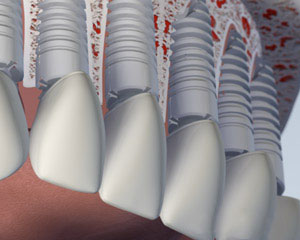
If you want a restoration that is most similar to your natural teeth and not removable, you may need eight to ten individual implants placed. After tissue healing and bone integration of the implants, individual abutments and new replacement crowns are placed on each implant.
It is very important to remember that with all of these options, continuing care by both the restoring dentist and Dr. Burns is necessary.